Morocco’s “Golden Coast” has long been the North African mecca for wave hunters. When you imagine surfing here, your mind likely jumps to the iconic images of Taghazout—the bustling hub that put Moroccan surf on the map.
But there is a secret known to surf instructors and seasoned expats: If you actually want to learn to surf—not just watch others do it—you go to Tamraght. While Taghazout thrives on its reputation and party-heavy hostels, Tamraght offers the quiet, consistent, and safe environment required to master the pop-up technique. In this guide, I’ll show you why this hillside village is the ultimate “classroom” for your first Atlantic swell.
1. The "Beginner’s Sanctuary":
Tamraght acts as a natural sanctuary because of its geography. Tucked slightly behind the headlands of Taghazout Bay, the village looks out over wide, welcoming bays that filter the raw energy of the Atlantic Swell.
Sandy Bottoms vs. Sharp Reefs:
Safety is the primary reason to choose Tamraght. Many world-class spots nearby are “point breaks” that break over jagged volcanic rock or sea urchins.
Tamraght’s primary learning spots, Crocro and Banana Beach, are wide, sandy-bottomed beach breaks. This means when you fall—and you will fall—your only landing pad is soft sand. This lack of consequence allows you to focus entirely on your feet rather than worrying about what’s beneath the surface.
Consistency: The 365-Day Surf Window
Morocco is famous for its winter swells, but Tamraght is a year-round destination. With over 300 days of sunshine annually, the conditions are remarkably stable.
Even when the massive winter swells make the famous points too dangerous for learners, the “sheltered corners” of Tamraght remain rideable. You get the benefit of the power from the Anti-Atlas Mountains’ coastal geography without the life-threatening intensity.
Spot Difficulty & Comparison Table:
| Spot Name | Wave Type | Bottom | Difficulty | Best For |
| Crocodiles | Beach Break | Sand | 1/10 | First-timers & White water |
| Banana Beach | Beach Break | Sand | 2/10 | Improving your paddle power |
| Devil’s Rock | A-Frame | Sand/Rock | 4/10 | Your first “Green Waves” |
| Banana Point | Point Break | Sand/Rock | 5/10 | Long, mellow rides |
| Anchor Point | Point Break | Reef/Rock | 10/10 | Experts only (Taghazout) |
2. Tamraght vs. Taghazout:
If you are looking for the best surf village in Morocco, you’ll likely find yourself choosing between these two neighbors. They are only 5km apart, but they feel like different worlds.
Sanitation and Your Health:
I’ll be direct about a “pain point” most blogs ignore: water quality. Taghazout has struggled with rapid growth, and its sewage infrastructure has often failed to keep up.
For a beginner who is inevitably going to swallow some seawater, this matters. Tamraght’s beaches are significantly cleaner. Because the village is less densely packed and sits on an open stretch of coast, the water circulation is better, keeping you in the water and out of the pharmacy.
The Vibe Check: Social vs. Zen
Taghazout is the place for late-night rooftop parties and a bustling, crowded atmosphere. It’s exciting, but it can be exhausting if your goal is physical progression.
Tamraght offers a “Slow Travel” ethos. It is a quiet, authentic village where the social life revolves around a Moroccan Mint Tea after a sunset session rather than a pub crawl. For the Active Relaxer, this peace is the foundation of a successful holiday.
Proximity to "Banana Village" (Aourir):
Tamraght is the gateway to Aourir, affectionately known as Banana Village. This gives you access to local prices, authentic Tajines, and the famous Wednesday market (Souk). You get the surf lifestyle without the “tourist tax” often found in the heart of Taghazout.
3. Top 3 Surf Spots for Your First Week:
Learning to surf is a ladder. You don’t start at the top; you climb one rung at a time. Here is your roadmap for a week in Tamraght.
Crocodiles (Croco Beach): The White Water Playground
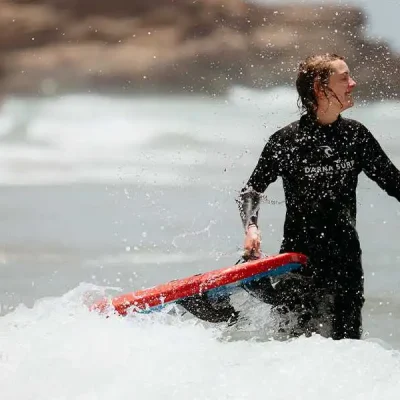
This is the ultimate nursery. The beach is massive, meaning there is plenty of room to practice your white water pop-ups without bumping into other students. The waves here break in long, straight lines, giving you a predictable platform to find your balance.
Devil’s Rock: Your First "Green Wave"
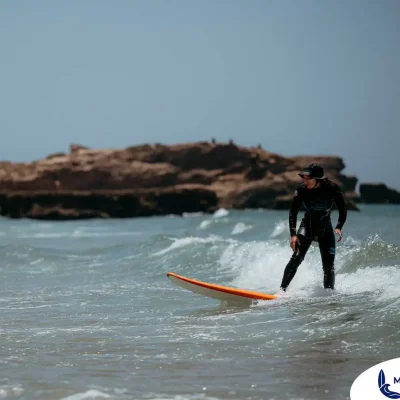
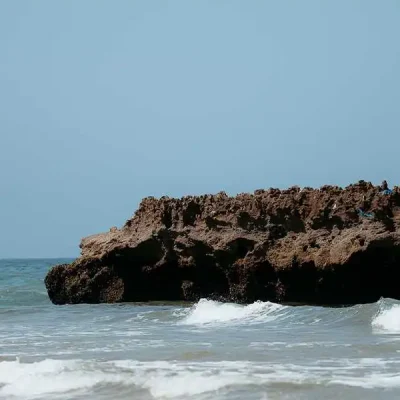
As you gain confidence, you’ll move to Devil’s Rock. This spot offers a more defined peak. Here, you’ll learn to catch “green waves” (waves that haven’t broken yet). It’s an “A-frame” wave, meaning it breaks both left and right, allowing you to practice your turns.
Banana Point: The Point Break Graduation
By the end of your first or second week, you’ll be ready for Banana Point. It’s a long, right-hand point break that is surprisingly mellow. It’s a sand-bottom point, which is a rarity, making it the safest place to experience the thrill of a 100-meter-long ride.
Pro-Tip: Handling the Devil’s Rock Paddle-out Don’t try to paddle straight through the middle. Watch the locals; they use the “channel” next to the rock itself where the water is deeper and the waves don’t break as hard. It saves your arms for the actual surfing!
4. The Surf Camp Advantage:
You might be tempted to rent a board and “DIY” your trip. While possible, I strongly advise against it for your first time in Tamraght for several logistical reasons.
The "Walk of Pain":
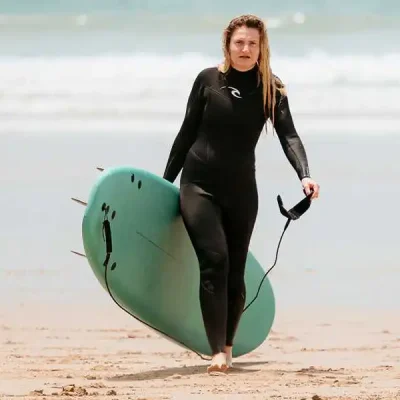
Tamraght is built on a stunning, steep hillside. While the view is incredible, carrying a heavy 9-foot foamie surfboard and a wet 3/2mm wetsuit up that hill after a two-hour session is brutal.
Surf camps aren’t just for lessons; they are for transport. Having a 4×4 drop you at the water’s edge and pick you up when you’re exhausted is the difference between a holiday and a chore.
Progression Through Video Analysis:
The biggest secret to learning to surf is seeing yourself on camera. Most professional camps in Tamraght use video analysis.
I’ve seen students struggle with their stance for days, only to fix it in ten minutes after seeing a replay of their “poop-man” stance. You simply cannot get this feedback when surfing solo.
All-Inclusive Value:
A typical surf camp in Tamraght costs between €500 and €700 per week. This usually includes:
Accommodation with ocean-view terraces.
Daily surf coaching and equipment.
Three Moroccan meals a day (including beach lunches).
Airport transfers from Agadir.
5. Beyond the Board:
When the tide is too high or your arms are too tired, Tamraght keeps giving. The lifestyle here is built around wellness and Amazigh (Berber) culture.
Yoga & Recovery:
Surfing works muscles you didn’t know you had. Almost every camp in the village offers sunset yoga. Stretching your hip flexors and shoulders while looking out at the Atlantic is the best way to ensure you can actually get out of bed for your 8:00 AM session the next day.
The Digital Nomad Scene:
Tamraght has recently become one of the top Digital Nomad hubs in North Africa. If you need to check emails between sessions, cafes like Hey Yallah or Nafas offer high-speed Wi-Fi and a community of like-minded remote workers. It’s the perfect spot for a “workation.”
Cultural Immersion:
The village remains deeply rooted in tradition. You can visit a local Hammam (a traditional steam bath) to scrub away the salt and sand, or take a cooking class to learn the secret of a perfect Argan oil infused tajine.
Conclusion: Is Tamraght Right for You?
If you want loud clubs and crowded line-ups, Taghazout is your place. But if you want to learn to surf in Morocco with cleaner water, safer beaches, and a supportive community, Tamraght is the undisputed champion.
It provides the physical and mental space to fail, get back up, and finally experience that life-changing moment of gliding across the water.
Frequently Asked Questions (FAQ):
1. Is it safe for solo female travelers?
Yes, Tamraght is exceptionally safe. The community is tight-knit, and the locals are famously hospitable. As with any travel, respect the local Amazigh culture by dressing modestly when walking through the village.
2. What wetsuit thickness do I need in January?
The water stays around 17-19°C. A 3/2mm wetsuit is standard, though if you feel the cold, a 4/3mm will keep you comfortable for longer sessions in the mid-winter months.
3. Do I need a car?
If you stay at a surf camp, no. They handle all transport. If you are going “DIY,” a car is helpful for exploring spots like Imsouane or the Paradise Valley rock pools.