We’ve all had that dream. You’re gliding across a glassy, turquoise wall of water, the salt spray on your face, feeling completely weightless. Then, the reality check hits. You think about the freezing water, the intimidating “locals,” and the fear of looking like a flailing mess on a surfboard.
Most people try to teach themselves. They rent a beat-up board, head into the soup, and spend three days getting exhausted without ever standing up. It’s frustrating, painful, and honestly, a bit soul-crushing.
But what if you could skip the years of trial and error? Our 7-Day Surf Coaching Program is designed to take you from a complete novice to a confident surfer who understands the ocean’s rhythm. We don’t just give you a board; we give you a technical roadmap.
Technical Roadmap: Day-by-Day Evolution
Days 1-2: Building the Foundation (The Beach & The White Water)
Your journey begins on the sand. Before we even touch the water, we focus on the physics of flotation and your stance width.
We start with the pop-up technique. Most beginners make the mistake of “climbing” onto the board using their knees. We teach a “one-motion” explosive move that ensures you land with your center of gravity over the stringer.
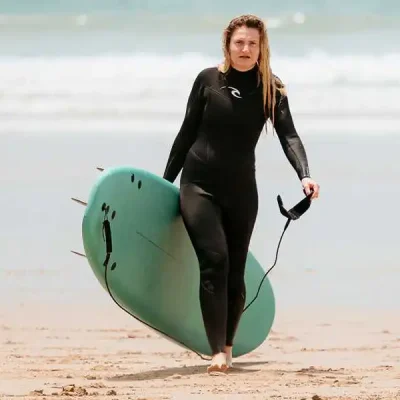
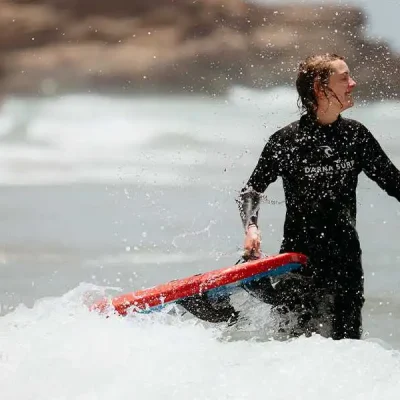
Once in the water, you’ll stay in the “white water” (the foam). This is where you learn to manage your soft-top longboard and understand leash safety. You’ll practice catching the energy of the wave and finding your “trim line”—the sweet spot on the board where you aren’t sinking the tail or diving the nose.
Pro-Tip: Look at the horizon, not your feet. Your body follows your eyes. If you look down at the board, that’s exactly where you’re going to land.
Days 3-4: Understanding the Ocean (Reading Waves & Paddling)
This is the “Hero” phase. We move “out back”—beyond the breaking waves into the line-up.
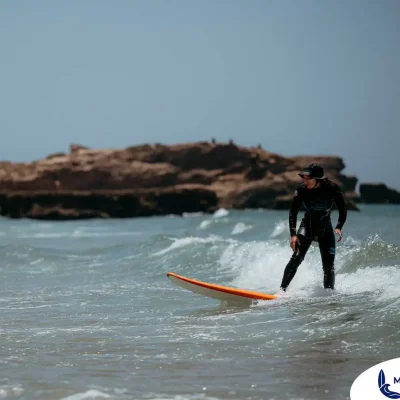
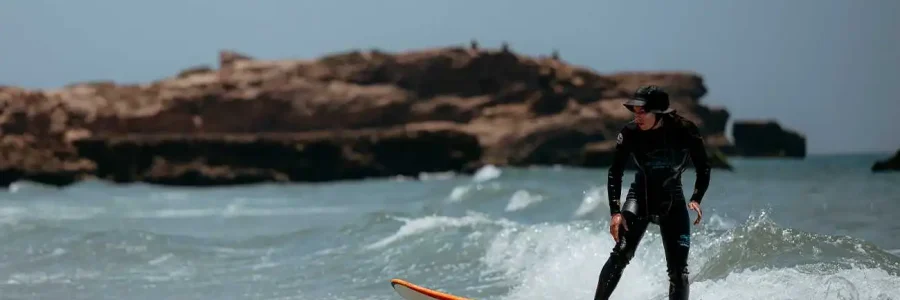
This is where you catch your first unbroken green wave. It feels like sliding down a hill of glass. We focus on wave reading and the trim line, teaching you how to slightly weight your front foot to gain speed or your back foot to steer.
We also cover the “unwritten rules” of the ocean. Surfing has a strict hierarchy and social code to keep everyone safe.
The Secret Sauce:
If you want to improve fast, you have to see yourself. Most surfers think they look like Kelly Slater, but the footage usually reveals the dreaded “poop-man stance” (knees apart, back hunched).
Every second day, we film your sessions from the beach. In the evening, we sit down for video analysis. We freeze-frame your pop-up to see exactly where your foot placement is off by two inches.
We then use dry-land drills on specialized balance boards or “surf-skates” to correct these movements. This creates a feedback loop that accelerates your learning by 300%.
| Common Mistake | The Consequence | The Video Correction |
| Knee-to-Board | Slow pop-up, loss of balance | “Cobra” stretch to instant feet placement |
| Stance too narrow | Board wobbles side-to-side | Widening stance to shoulder-width |
| Looking at the nose | Nose-diving into the water | Chin up, looking at the beach/shoulder |
Beyond the Board:
You don’t need to be an Olympic athlete to start, but surfing is a full-body workout. We address the “Am I fit enough?” fear by focusing on functional movement rather than raw strength.
Paddle endurance is usually the first thing to go. We’ll teach you how to use your lats and core rather than just your shoulders. We also incorporate breathwork. Learning how to calm your heart rate after a wipeout is the key to overcoming the “fear factor” of bigger waves.
The 5-Minute Pre-Surf Warm-Up:
Arm Circles:
Lubricate the shoulder joints.
Dynamic Lunges:
Wake up the hip flexors for the pop-up.
Cobra-to-Plank:
Mimics the movement of catching a wave.
Squat Jumps:
Prepares the legs for the sudden weight load.
Life at the Camp:
The “Hero” transformation isn’t just about the salt water; it’s about the community. Our camp is designed for high-level learning but also for total relaxation.
Between sessions, you’ll be fueled by nutritious, locally sourced meals designed to keep your energy levels high without making you feel heavy in the water. In the evenings, the “Après-surf” culture takes over. You’ll swap stories of your best rides and funniest wipeouts with people from all over the world.
A Typical Day in the Life:
07:00 AM:
Fresh coffee and a light pre-surf breakfast.
08:30 AM:
Morning Session (focused on technical drills).
12:30 PM:
High-protein lunch and “hammock time.”
03:00 PM:
Afternoon Session (free-surf with coaching oversight).
06:00 PM:
Video Analysis and Sunset Social.
08:00 PM:
Family-style dinner and oceanography talk.
Frequently Asked Questions (FAQ):
1. What if it rains?
Surfing is one of the few sports where rain doesn’t matter—you’re getting wet anyway! In fact, rainy days often bring “glassy” conditions because the wind dies down. Unless there is lightning or extreme wind, the coaching continues.
2. Do I need to be a strong swimmer?
You should be comfortable in the water and able to swim at least 50 meters unassisted. However, for the first few days, we stay in waist-deep water where you can always touch the bottom.
3. Can I join if I'm over 40?
Absolutely. We’ve coached students in their 60s. We adjust the equipment—using high-volume soft-top longboards—to make the process easier on your joints and maximize your wave count.
Your First Wave is Only 7 Days Away
Going from “Zero to Hero” isn’t about natural talent; it’s about having the right gear, the right environment, and a proven technical system.
By the end of these seven days, you won’t just be standing up—you’ll be reading the ocean, respecting the etiquette of the line-up, and feeling that unmistakable “stoke” that only surfers understand.
The ocean is waiting. Are you ready to answer?